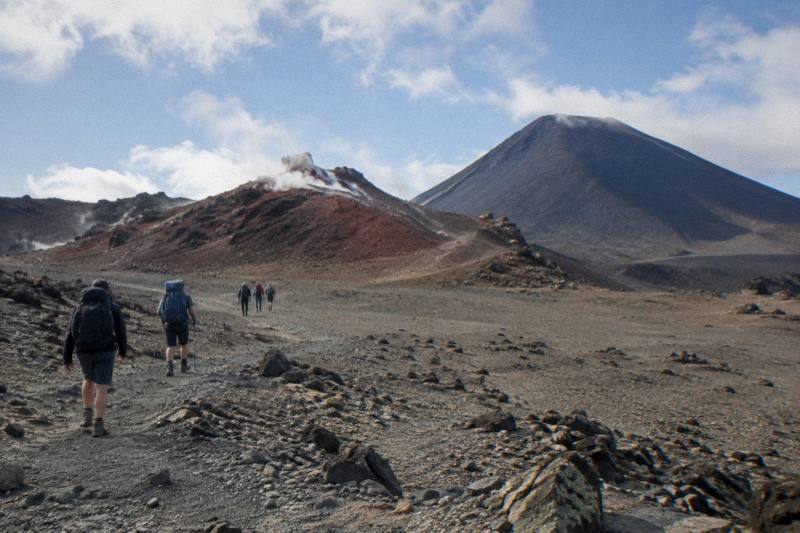
Northern Circuit Or Crossing: Which Hike Reaches The Emerald Lakes
Both walks share the same crater country around Red Crater, but only one of them is a day walk to the Emerald Lakes, and the difference shapes everything from your booking to your boots.
Short answer
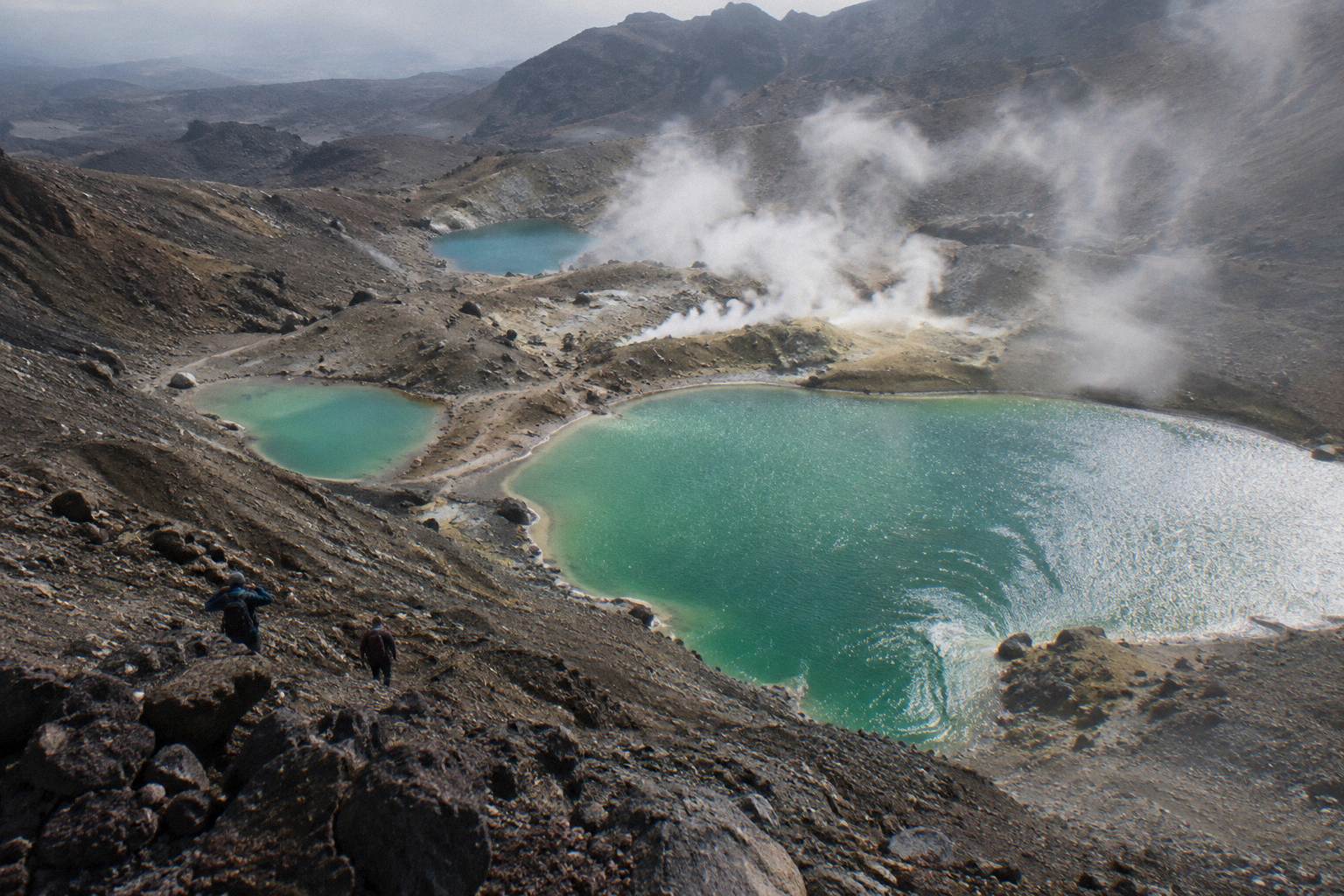
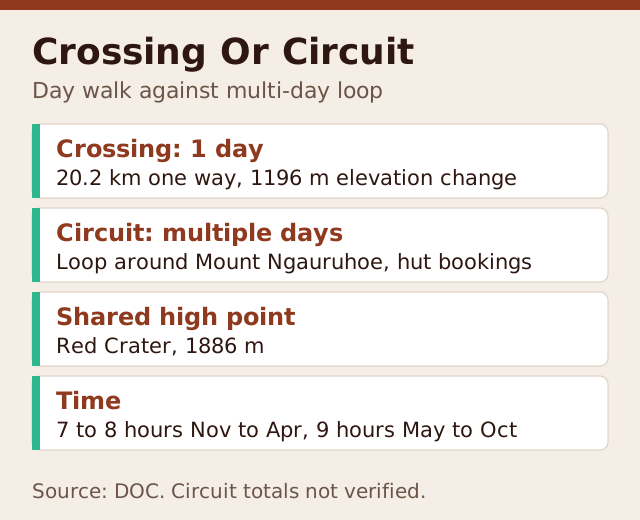
The Tongariro Alpine Crossing is a 20.2 km one-way day walk that passes the Emerald Lakes between Red Crater and Ketetahi, taking 7 to 8 hours from November to April. The Tongariro Northern Circuit is a multi-day loop around Mount Ngauruhoe that includes the same lakes section, so both reach them, but the Crossing is the practical day choice for most walkers.
The Tongariro Alpine Crossing runs 20.2 km one way, climbs and drops 1196 m, and threads the Emerald Lakes on its descent from Red Crater at 1886 m, the highest point on the walk. The Tongariro Northern Circuit is a different animal entirely: a multi-day Great Walk loop that shares that same high country but adds huts, nights, and a much bigger commitment. Both stand in Tongariro National Park, New Zealand's oldest national park and a dual World Heritage area, and both belong to the same sacred maunga of Ngati Hikairo ki Tongariro of Ngati Tuwharetoa.
This comparison sits inside a wider set of track guides: the full picture of the Emerald Lakes on the Tongariro Crossing is the place to start if the lakes themselves are the mission, and the Red Crater Tongariro hike covers the climb that sits above them.
| Quick fact | Tongariro Alpine Crossing | Tongariro Northern Circuit |
|---|---|---|
| Shape | One-way day walk, 20.2 km | Multi-day loop around Mount Ngauruhoe |
| Reaches Emerald Lakes | Yes, between Red Crater and Ketetahi | Yes, shares the same section |
| Season walking time | 7 to 8 hours Nov to Apr, 9 hours May to Oct | Spread across multiple days |
| Highest point | Red Crater, 1886 m | Shares the Crossing's high country |
| Elevation change | +/- 1196 m (DOC) | Not verified for the full loop, compare via DOC |
| Fitness rating | High (DOC) | Multi-day tramping fitness |
| Winter status | Expert route May to Oct, guide recommended | Alpine conditions, guide recommended |
| Typical booking | Shuttle or guided day tour | Hut bookings via the DOC system |
What Is The Difference Between The Tongariro Northern Circuit And The Crossing?
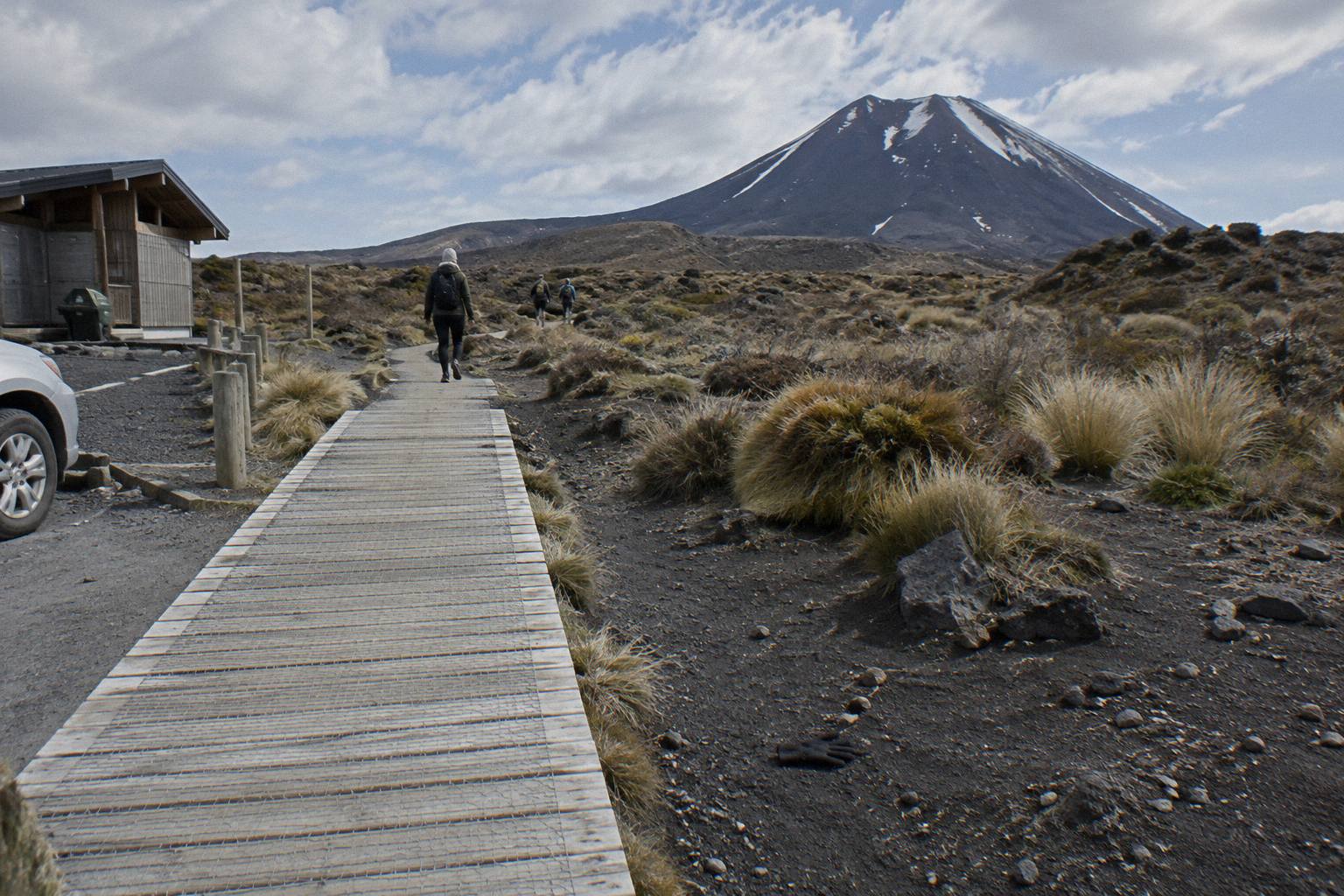
The Crossing is a one-way 20.2 km day walk with a single high point at Red Crater, 1886 m, which DOC rates High fitness and an intermediate tramping track in summer. The Northern Circuit is a multi-day loop that folds the Crossing's central section into a longer route around Mount Ngauruhoe, adding hut nights and route-finding across several days.
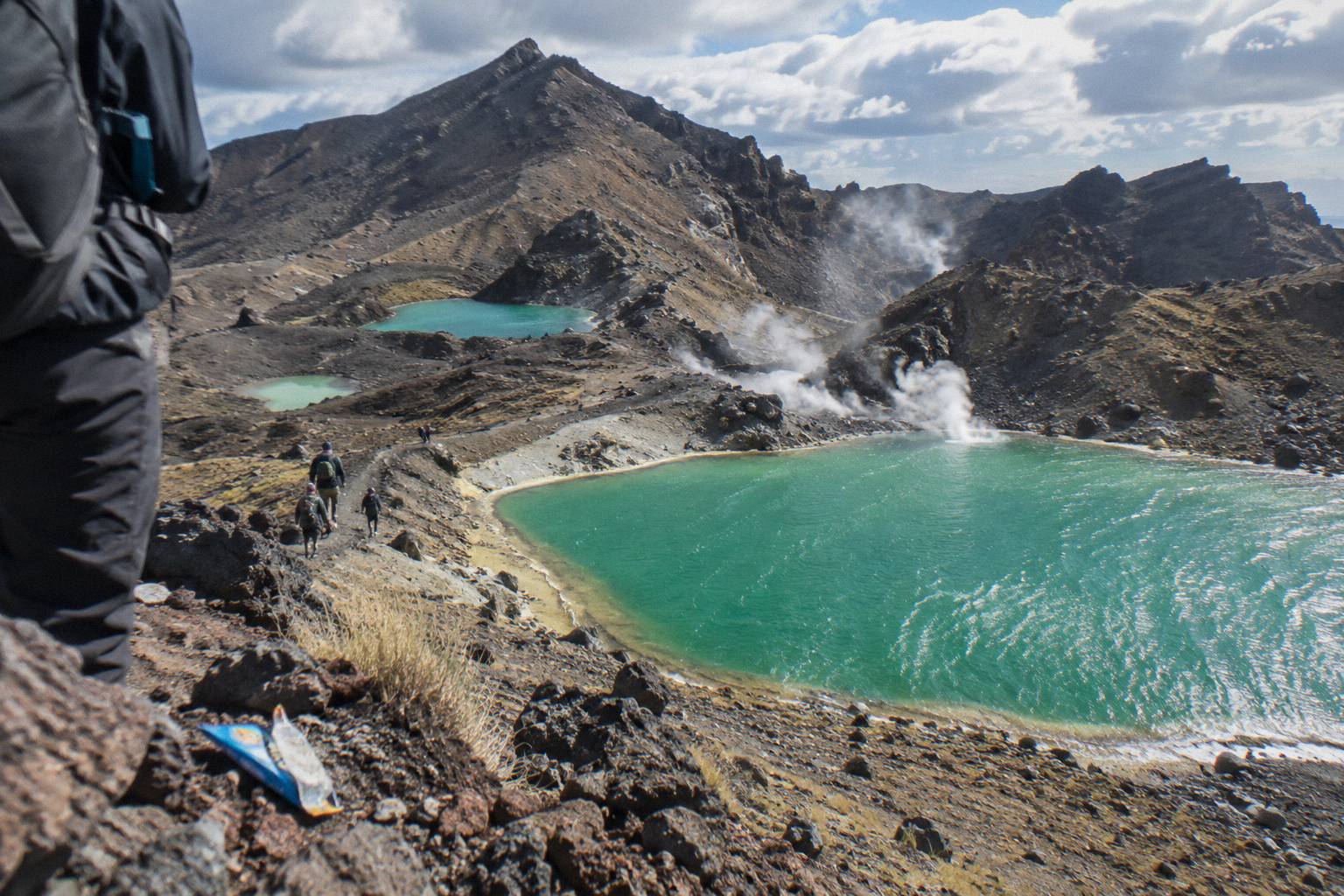
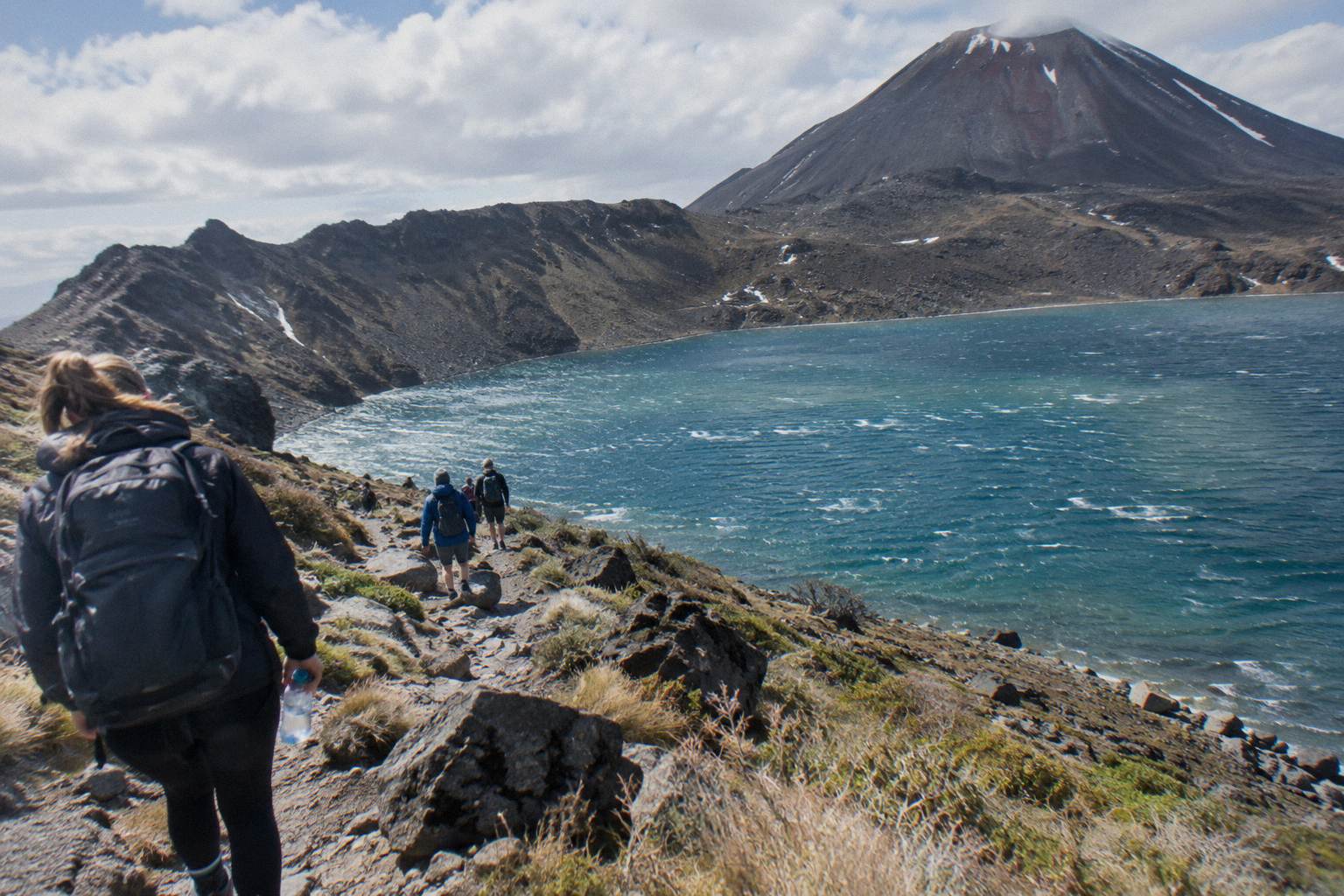
The practical shape of the difference is simple. Walk the Crossing and you start at Mangatepopo, climb the Devil's Staircase, cross South Crater, summit Red Crater, and drop the steep scree to the vivid Nga Rotopounamu, the Emerald Lakes, before the long descent past Blue Lake to Ketetahi Road. One day, one shuttle booking, one very long walk. The Circuit instead loops the whole mountain, sharing the Mangatepopo start and the Red Crater to Emerald Lakes section, then continuing where the Crossing turns downhill, linking huts and valleys over multiple days.
That shared section matters for this comparison. Everything people say about the lakes, the scree descent from Red Crater, and the crowded staircase in peak season applies to both tracks equally. What differs is what happens before and after: the Crossing finishes downhill to a shuttle pick-up, while the Circuit keeps walking, and keeps needing hut bookings, food planning and several days of weather windows rather than one.
Neither track is a stroll. DOC's own page for the Crossing is blunt that fitness should be high, that the 9 hour May to October band reflects snow, ice and avalanche risk, and that alpine skills are essential in winter, with a guide the recommended way to go. The full DOC track page covers both tracks' details, and the DOC booking system is free, recommended for the Crossing, and needed before shuttle and guided products can be tied together.
Which One Actually Reaches The Emerald Lakes?
Both do, and by the exact same path. The Emerald Lakes sit directly below Red Crater on the section of track the Crossing and the Northern Circuit share, reached by a steep scree descent from the 1886 m rim. The difference is that the Crossing delivers you there in one push of 7 to 8 hours in summer, while the Circuit delivers you there partway through a multi-day loop, with the lakes as one highlight among several.
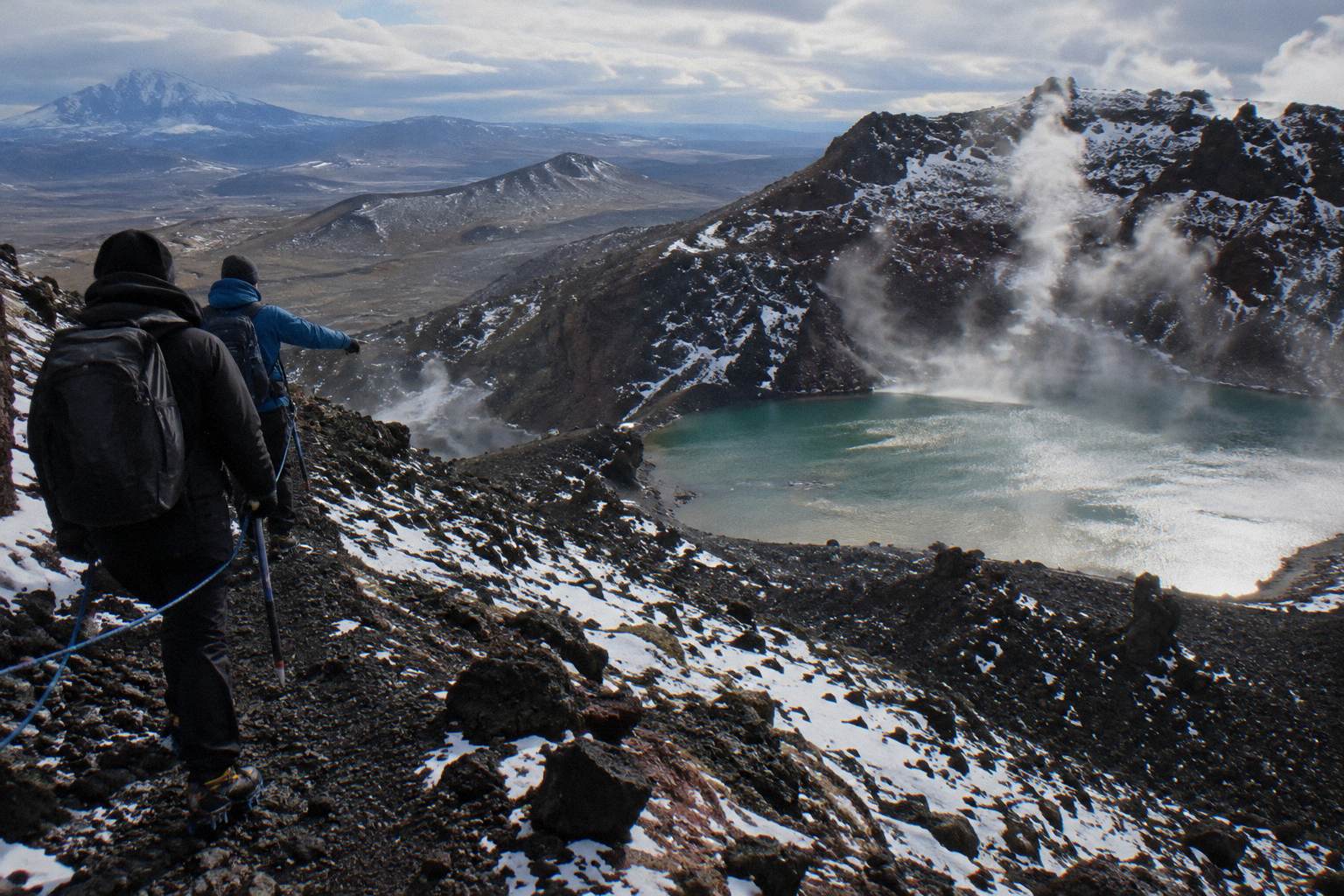
For most people asking this question, the honest answer is that the lakes are not the reason to choose the Circuit. They are the reason to choose either. If your whole aim is to stand above those three green pools and photograph them, the Crossing gets you there with one booking, one early start and one set of legs. The walk time to the Emerald Lakes and the distance and elevation to the Emerald Lakes break down that day in detail, including where the lakes fall along the 20.2 km route.
The Circuit's argument is different. It offers solitude in the back half of the loop, valley camps and huts the day-walk crowd never sees, and a slower rhythm through country that the Crossing crosses at speed. But it costs more days, needs hut bookings through DOC, and still demands the same alpine judgement on the shared high section if the weather turns. DOC's cultural request applies on both: Kaumatua Te Ngaehe Wanikau asks visitors to respect the maunga tapu by not touching or entering any of the waterways, including the alpine lakes. That request, printed on the DOC page, is the reason no swim stop appears in any plan for either track, a point the swimming in the Emerald Lakes guide covers fully.
Getting to the shared section is where bookings enter. Three broad paths exist: a round-trip shuttle from National Park Village or Taupo, a one-way park-and-ride from the Ketetahi end, or a guided day tour.
How Do The Two Hikes Compare On Time, Effort And Fitness?
The Crossing is a single day of 7 to 8 hours between November and April, 9 hours from May to October, with 1196 m of elevation change over 20.2 km and a High fitness rating from DOC. The Circuit spreads comparable and greater effort across multiple days, which changes the fitness question from one long effort to sustained back-to-back days; DOC publishes the Circuit's own track details rather than a single verified figure reused here.
The fitness question is really a question about your worst hour, not your average one. On the Crossing, the worst hour is the Devil's Staircase and the climb to Red Crater, back to back, at altitude, often in wind. There is no hut at the top to recover in, no splitting the climb over two days, no option to rest and continue tomorrow. The fitness for the climb to the Emerald Lakes guide covers how to prepare for exactly that hour. On the Circuit, you carry the same climb but you also carry everything for days, which trades a single brutal effort for sustained load and longer exposure to weather.
Time of year tilts the comparison hard. In summer the Crossing is an intermediate tramping track with shuttle infrastructure around it. From May to October DOC classes it an Expert route, with snow, ice, avalanche risk and sub-zero temperatures, and says alpine skills are essential and a guide is the best way to go. The Circuit in the same months is a full winter tramp. Neither is a shoulder-season stroll, and DOC advises checking conditions and its alerts before either walk.
| Comparison point | Crossing as a day walk | Circuit as a multi-day loop |
|---|---|---|
| Days needed | 1 | Multiple |
| Walking time | 7 to 8 hr Nov to Apr, 9 hr May to Oct (DOC) | Spread over the loop's days |
| Highest point | Red Crater, 1886 m | Shares Red Crater |
| Elevation change | +/- 1196 m | Greater total over the loop, verify with DOC |
| Fitness demand | One long high effort | Sustained days with a pack |
| Booking load | Shuttle or guided tour, plus free DOC booking | Hut bookings plus track transport |
| Weather exposure | One day's window | Several days' windows in sequence |
| Best for | Visitors with one day and a lakes goal | Walkers wanting nights out and solitude |
Effort also decides who should be guided. Adrift Tongariro runs the three guided tours among these products, including the premium guided hike, from NZ$450 per person, rated 4.6 across 242 reviews, and the private guided Crossing, rated 4.5 across 30 reviews. Guided means crampons and ice axes supplied for winter conditions if required, plus a clothing and footwear allowance, though lunch is not included, so bring your own. A shuttle never includes a guide of any kind; it is transport to and from the track only.
What About Transport, Huts, Bookings And Cost?
For the Crossing, book transport before anything else: a shuttle or a guided tour, since DOC limits road-end parking to a 4 hour maximum from Labour weekend in late October to 30 April and suggests a shuttle; the free DOC Crossing booking is recommended and needed for shuttle and guided arrangements. For the Circuit, hut bookings through DOC's system are the spine of the trip, with fees and availability on DOC's own pages.
The parking rule is the single fact that pushes almost every Crossing walker into a shuttle seat. From Labour weekend to 30 April, the 4 hour maximum at the road ends makes parking at Mangatepopo and walking impractical, and DOC says outright there is no Crossing walker parking at Mangatepopo car park in summer, with a private car park near Ketetahi as the alternative at that end. A walker who has come for the lakes should read that as: the transport booking is not optional, it is part of the walk. The shuttle timetable for the Emerald Lakes day and the Mangatepopo car park start guide cover the mechanics.
The most reviewed tour here, with 890 reviews and a 4.7 rating, is the Tongariro Crossing Shuttles round-trip from National Park Village, from NZ$75 per person, with free cancellation up to 24 hours before. It departs the Park n Ride at 59 Findlay Street and returns you there after the walk. Park-and-ride products work the other way round: the Ruapehu Scenic Shuttles Ketetahi park-and-ride, from NZ$68 per person, rated 4.8 across 670 reviews, has you park at the Ketetahi end, ride to Mangatepopo, and walk the Crossing back to your own car, one-way transport with no return leg.
From Taupo or Turangi, the Tongariro Expeditions Crossing shuttle covers both towns, from NZ$75 per person, rated 4.7 across 431 reviews, with free cancellation up to 24 hours before. DOC says part of a shuttle fee, about NZ$40, goes to conservation, which is the closest thing to a "what your fare supports" fact worth knowing when comparing seats.
For the Circuit, the planning list inverts. Huts come first, days are built around them, and transport is a smaller bookend problem because you finish close to where you started. DOC's booking pages carry hut availability and fees for the Great Walks season, and no figure for those is verified here, so check DOC directly rather than any secondhand number.
| Booking question | Crossing answer | Circuit answer |
|---|---|---|
| What must be booked? | Shuttle or guided tour, plus free DOC booking | Hut nights via DOC |
| Parking in season | 4 hr max at road ends, DOC says book a shuttle | Road-end parking rules still apply to your start day |
| Typical cost anchor | Shuttles from NZ$68 to NZ$75 per person where priced | Hut fees on DOC's pages |
| Cancellation | Free cancellation up to 24 hr before on the shuttles named here | Hut booking terms via DOC |
| Auckland option | Multi-day private tours exist, the walk leg is self-guided | Long way; overnight or two-day products exist |
Auckland-based readers have a third path, though it is neither guided nor a shuttle: the Kiwi Road Tours private transfer from Auckland, and the ExperienceKart private three-day tour from Auckland, which includes Huka Falls and Lake Taupo with the Crossing as one self-guided leg, not suitable under 12. Auckland is a long way from the mountain; no hours are worth quoting, but multi-day products acknowledge the distance.
Which Walk Suits Which Walker?
Choose the Crossing if the Emerald Lakes are the goal and you have one day: it delivers the full high section in a single push, supported by shuttles and guided options from five departure points. Choose the Circuit if you have several days, want hut nights and quiet valleys, and accept heavier planning. Families, first-timers and time-poor visitors belong on the Crossing; multi-day trampers with their own gear belong on the Circuit.
The day-walk case is the stronger one for most international visitors. One booking, one early start, and the sunrise start on the Crossing tactic gets you ahead of the crowds on the staircase. National Park Village makes a convenient base: five products depart there, including the Tongariro Crossing Shuttles round trip already covered, and the Dempsey Buses return bus from National Park Village, from NZ$90 per person, rated 4.8 across 72 reviews, which serves the Park Hotel Ruapehu and Tongariro Crossing Lodge as well as the Park n Ride.
Taupo-based walkers have a genuine decision between driving closer the night before or riding from town. The Tongariro Expeditions shuttle from Taupo or Turangi handles both towns, and DOC lists Taupo as 86.5 km from the track, a distance worth weighing against an early start. Turangi, at 36.7 km, is the closer sleep: the Taupo to the Emerald Lakes day plan lays out both patterns.
The guided case deserves its own hearing. A guide is not a luxury in the May to October window; DOC's own wording is that it is best to go with a guide when the route is an Expert one. Even in summer, walkers who want the geology explained, the pace managed and the weather call taken by someone who reads it daily will find the premium guided hike earns its price. The is a guide worth it for the Emerald Lakes section comparison works through the judgement honestly.
Private groups, small weddings of fitness, corporate days and parents of near-teenagers should note the age rules where they exist: the full-day guided Adrift Tongariro Crossing sets a minimum age of 12, the premium and private tours point to the booking page for age limits, while shuttles carry their own terms, and DOC advises the track is not recommended for children under 10. There is no single site-wide age; each product's own booking page shows its rule. More of these guides are collected on Tongariro Emerald Lakes Hike.
| Walker type | Better pick | Why |
|---|---|---|
| One day, lakes are the goal | Crossing | 7 to 8 hr day delivers Red Crater and the lakes |
| Several days, wants solitude | Circuit | Loop adds valleys and huts the day walk skips |
| May to October travel | Guided Crossing | DOC calls winter an Expert route, guide recommended |
| Auckland base | Multi-day tour or transfer | Long way; overnight or two-day products exist |
| First alpine walk | Guided Crossing | Gear supplied on Adrift tours, weather call taken for you |
| Family with teens | Round-trip shuttle Crossing | Simple logistics, free cancellation up to 24 hr before |
What Trips People Up When Choosing Between The Two
The recurring mistakes are treating the Circuit as a longer Crossing, assuming summer conditions into the winter months, parking at the road ends in season, and confusing shuttle transport with a guided walk. Each error comes from maps that look similar on screen: the tracks share their most dramatic kilometres, and the differences live in bookings, seasons and logistics rather than scenery.
The first mistake is assuming the Circuit is just the Crossing plus extra days, which leads to packing for a day walk for a multi-day tramp. The gear lists are different animals. DOC's own winter essentials for independent trips list crampons, ice axe, helmet, competency and avalanche gear; in summer the list shrinks but never to nothing, and the what to wear hiking to the Emerald Lakes guide covers the summer version. Among the tours here, crampons and ice axes are stated as supplied only on the three Adrift Tongariro guided tours, for winter conditions if required.
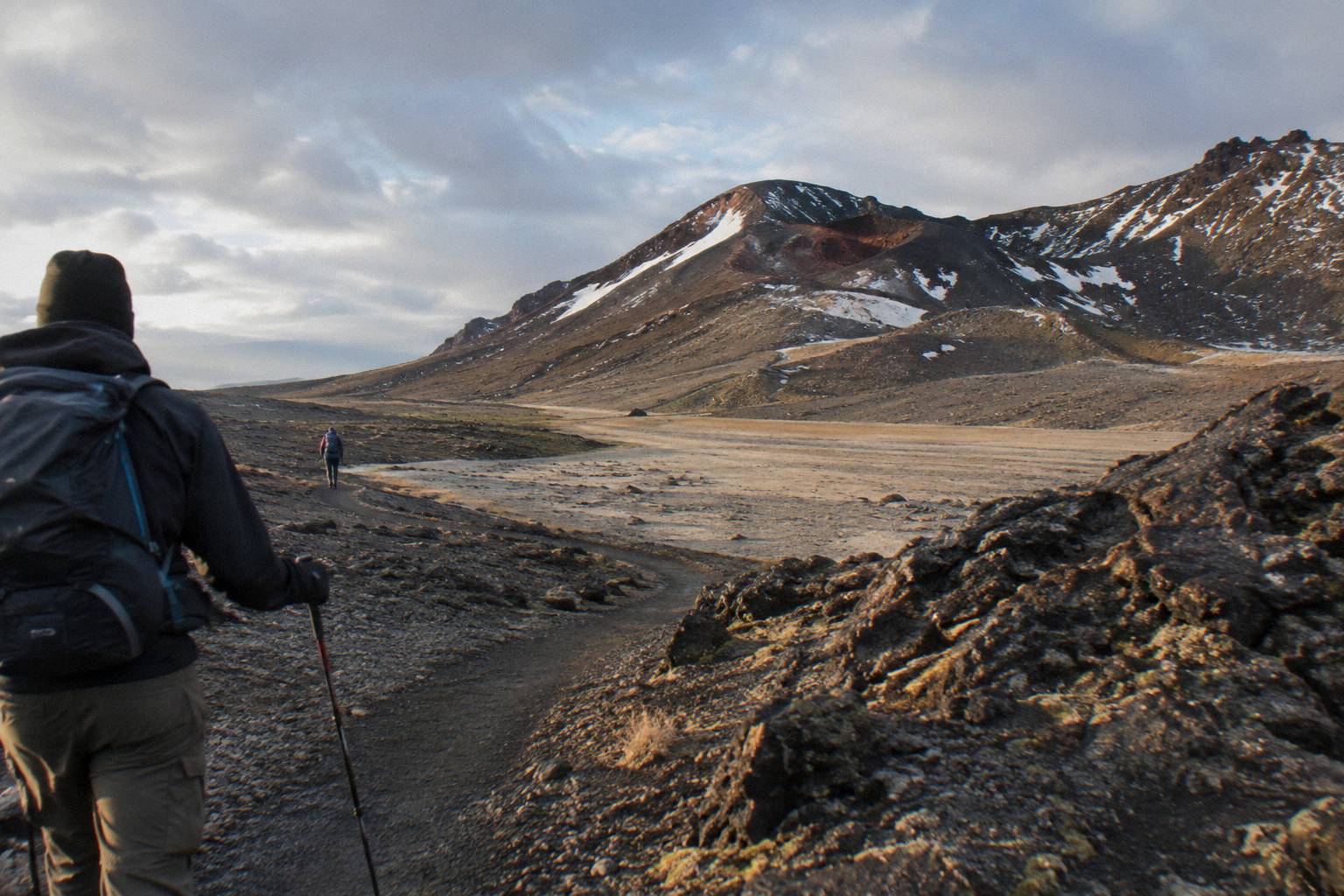
The second is calendar blindness. A walker who books a November shuttle and pictures October snow, or a May walker who pictures April crowds, has mismatched expectations twice over. DOC's walking time itself changes with the season, 7 to 8 hours in the November to April window against 9 hours from May to October, and the best month to hike to the Emerald Lakes and winter on the Crossing guides work through the trade-offs month by month.
The third is the parking trap, already covered above but worth naming as a mistake because it catches confident self-drivers every summer: the 4 hour maximum runs from Labour weekend to 30 April, and the walk takes at least 7. The fourth is calling a shuttle a tour. Shuttles here are transport, not guided walks, and a one-way park-and-ride is not a return. The Tongariro Expeditions Ketetahi park-and-ride, rated 4.3 across 106 reviews with free cancellation up to 24 hours before, is a well-reviewed example of the one-way format: you ride to the start and walk back to your own car, with no return transport at all.
When The Weather Turns: Which Track Copes Better?
Neither track copes with a bad forecast; both depend on it, and DOC's advisory system gates what operators may run. Guided operators and shuttles run only when the advisory and the forecast allow, conditions allowing is the operative phrase for every booking, and DOC points to Taranaki Falls and Tama Lakes as alternative walks when the high route is out.
This is where the comparison stops being about scenery. The shared high section, South Crater, Red Crater, the Emerald Lakes descent, is exposed alpine country where wind, not rain, is usually the problem. The Crossing walker can postpone a day; the Circuit walker mid-loop often cannot, which is the multi-day format's real risk. Volcanic alert levels change daily and GeoNet is the live source, while the NIWA advisory for the park and the Red Crater forecast are what operators watch each morning, with go and no-go decisions assessed each morning rather than on a fixed timetable.
For day walkers, the alternatives are genuine rather than consolations. Taranaki Falls and Tama Lakes both sit in the same national park and both deliver volcanic scenery without the alpine exposure, and the other hikes in Tongariro National Park guide covers them. A shuttle booked with free cancellation up to 24 hours before, as the round-trip and park-and-ride products here carry, makes postponement cheap. The Crossing weather above the Emerald Lakes guide explains how to read the forecast windows yourself.
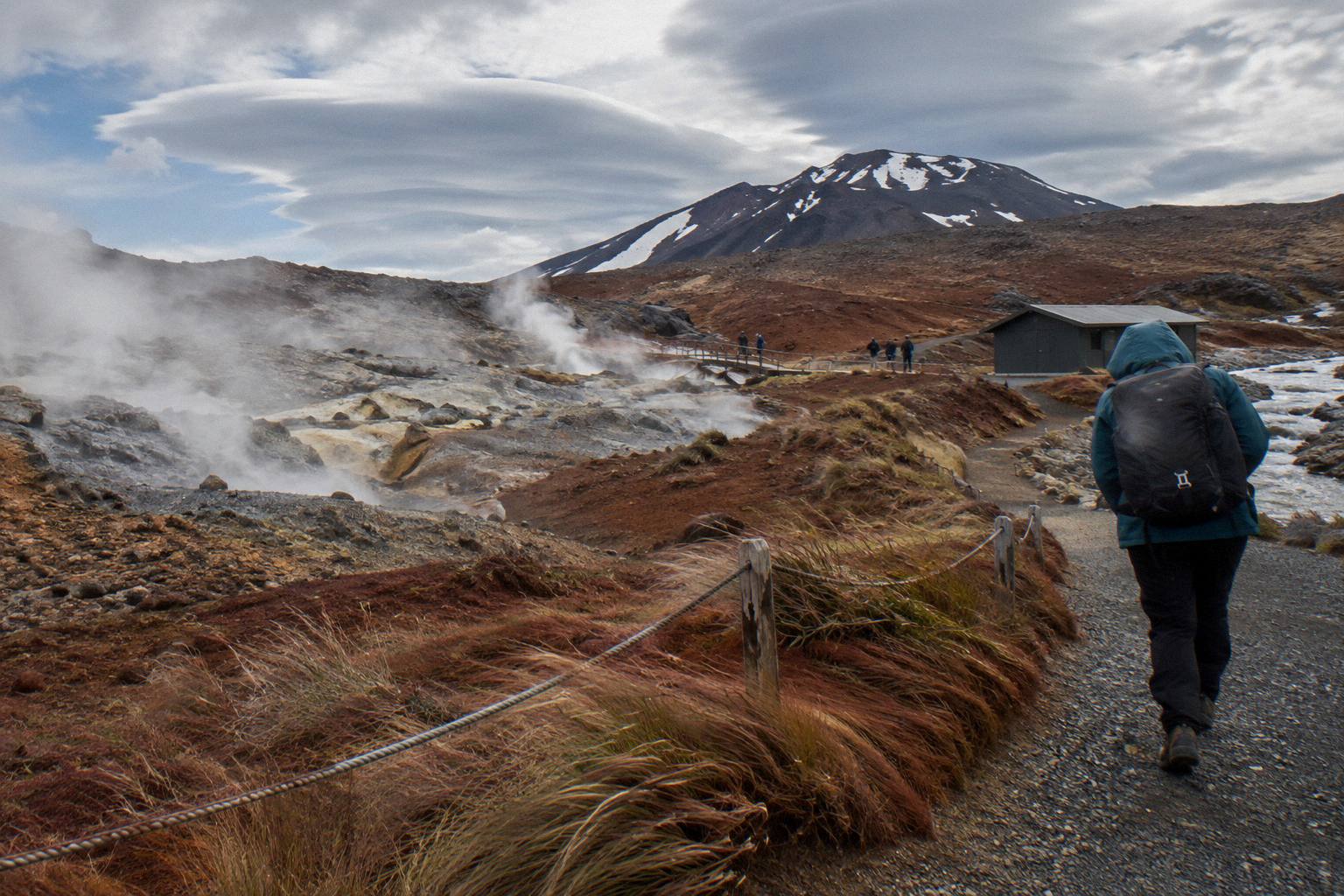
The Verdict: Book The Crossing Unless You Want The Nights
For a visitor whose goal is the Emerald Lakes, the Crossing is the right walk: shorter commitment, one booking for transport, every high-country highlight including Red Crater and the lakes, and guided options when the season demands them. The Northern Circuit earns its place only when hut nights, solitude and several days on the mountain are the point rather than the price.
That verdict is not a slight on the Circuit; it is a statement about goals. The lakes, the colours, the scree descent and the photographs live on the shared section, and the Crossing is the shortest honest route to all of it. Book transport early in the peak season, pick your departure point deliberately, and check the DOC advisory before you commit the day. Whether the seat is on the round trip from National Park Village, the Ketetahi park-and-ride, or a guided day with gear supplied, the walk above and below those lakes is the same unforgettable one.
Deciding between shuttle formats rather than tracks? The round-trip from National Park Village, the Ketetahi park-and-ride with your own car waiting at the finish, and the premium guided hike with gear supplied cover the three main ways walkers book this day.
Common Questions About The Northern Circuit Versus The Crossing
Does The Tongariro Northern Circuit Reach The Emerald Lakes?
Yes. The Circuit shares the Crossing's high section, so its walkers descend the same scree from Red Crater at 1886 m to the vivid Nga Rotopounamu, the Emerald Lakes. The difference is that the Circuit reaches that point partway through a multi-day loop, while the Crossing reaches it in a single 7 to 8 hour summer day.
Is The Northern Circuit Harder Than The Tongariro Crossing?
They demand different things. The Crossing is one long High-fitness day with 1196 m of elevation change over 20.2 km. The Circuit spreads effort across multiple days but adds pack weight, hut logistics and several consecutive weather windows. DOC rates the Crossing's summer form an intermediate tramping track and its May to October form an Expert route.
Can You Do The Northern Circuit As A Day Walk To The Lakes?
Not as the Circuit. The day walk that reaches the Emerald Lakes is the Tongariro Alpine Crossing itself, 20.2 km one way from Mangatepopo to Ketetahi Road, and it is the walk every shuttle and guided tour here supports. The Circuit exists to be walked over multiple days with hut bookings.
Which Is Better If I Only Have One Day?
The Crossing, without much argument. One day, one transport booking, and every headline sight including Red Crater, the Emerald Lakes and Blue Lake. From National Park Village a round-trip shuttle runs from NZ$75 per person with free cancellation up to 24 hours before, and a Ketetahi park-and-ride runs from NZ$68 per person.
Do Both Tracks Need The DOC Booking?
The DOC booking system is free and recommended for the Crossing, and is needed before shuttle and guided arrangements come together. Circuit walkers book hut nights through DOC's own system. Check the booking pages for hut availability and terms; no hut figure is verified here.
Are The Emerald Lakes Treated Differently On Either Track?
No. The same cultural request applies on both: Kaumatua Te Ngaehe Wanikau asks visitors to respect the maunga tapu by not touching or entering any of the waterways, including the alpine lakes. That means no swimming or wading on either walk, and it is a request DOC prints on the track page.
For more on the day itself, see whether it is worth hiking to the Emerald Lakes, how long the hike to Emerald Lake really takes, and whether you need a guide for the Tongariro Crossing.