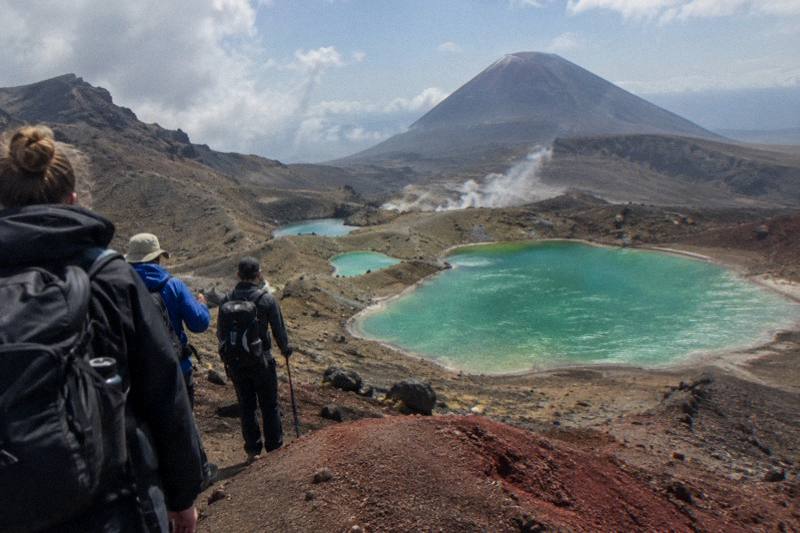
Emerald Lakes On The Tongariro Crossing: Where They Sit And How To Reach Them
The Emerald Lakes are the image most people carry of the Tongariro Crossing, three mineral-green pools tucked into the volcanic plateau just under Red Crater. This guide locates them on the track, explains the climb and descent around them, and lays out the shuttles and guided tours that put you on the start line.
Short answer
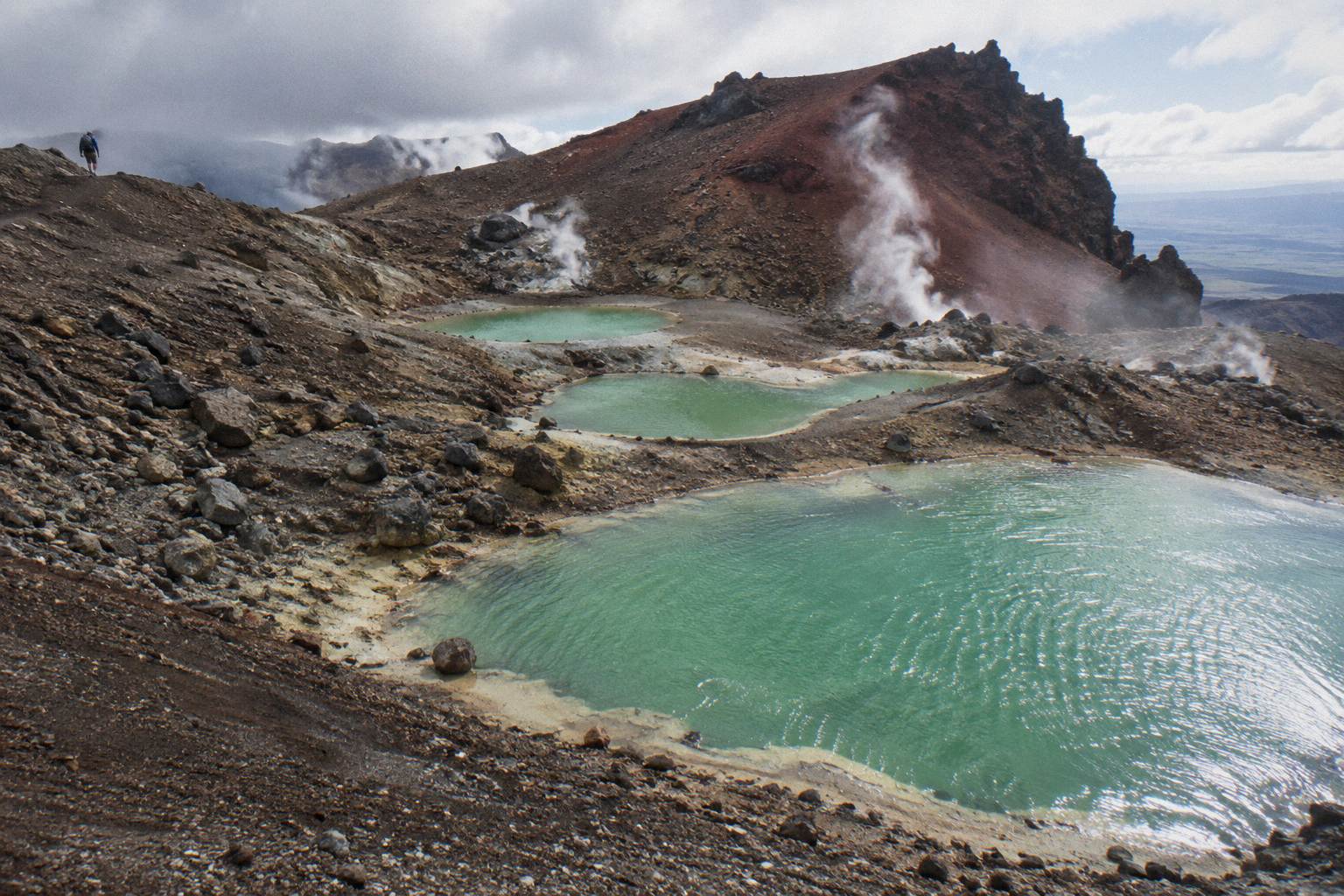
The Emerald Lakes sit part way along the 20.2 km one-way Crossing, reached after the Devil's Staircase and the South Crater traverse, directly below Red Crater at 1886 m. DOC rates the walk 7 to 8 hours in summer. Most walkers arrive by shuttle or guided tour because summer parking at the road ends is limited to 4 hours.
The Emerald Lakes, known in te reo Maori as Nga Rotopounamu, are three small, vividly green crater pools sitting on the volcanic plateau between Red Crater and Central Crater on the Tongariro Alpine Crossing. DOC describes the approach as a steep scree descent from Red Crater, which at 1886 m is the high point of the whole 20.2 km one-way track. They are not a side trip and not a viewpoint you drive to. They are the reward roughly two thirds of the way through a High-fitness alpine walk that DOC grades 7 to 8 hours from November to April, and 9 hours with Expert-route conditions from May to October.
| Quick Fact | Detail |
|---|---|
| Track | Tongariro Alpine Crossing, one way |
| Distance | 20.2 km one way (DOC) |
| Elevation change | Plus and minus 1196 m (DOC) |
| High point | Red Crater, 1886 m |
| Walking time | 7 to 8 hours Nov to Apr, 9 hours May to Oct (DOC) |
| Fitness grading | High (DOC) |
| Lakes access | On the track, below Red Crater, no side trip needed |
| Swimming | Visitors are asked not to touch or enter the lakes |
| Winter status | Expert route, alpine skills essential, guide recommended |
Where Exactly Do The Emerald Lakes Sit On The Crossing?
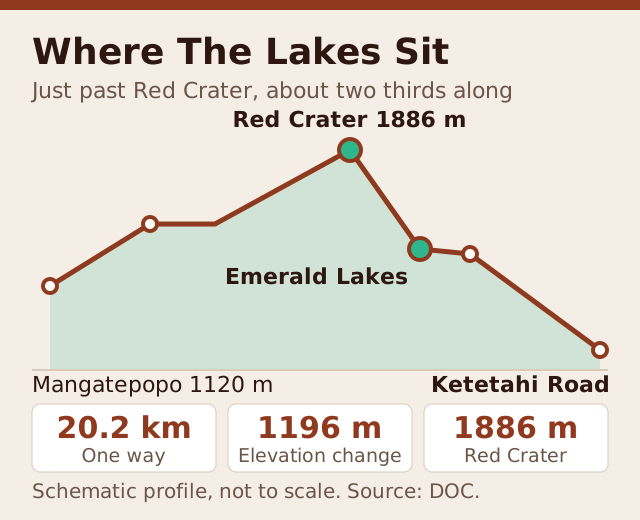
The Emerald Lakes sit on the eastern shoulder of the track, roughly two thirds of the distance from the Mangatepopo start to the Ketetahi Road finish, between Red Crater and Central Crater. There is no side track or detour: the track's own line passes the three green pools, reached by a steep scree descent straight off the Red Crater rim, on the volcanic plateau below the 1886 m high point.
The full Crossing runs one way, 20.2 km, from the Mangatepopo end up over the saddle, across South Crater, up the ridge to Red Crater, down the scree past the Emerald Lakes, across Central Crater, past Blue Lake and down the long Ketetahi descent. DOC records the total elevation change as plus and minus 1196 m. The walk starts at about 1120 m at Mangatepopo, tops out at Red Crater 1886 m and finishes near 760 m at Ketetahi Road, so the lakes arrive after most of the climbing is done and before the longest descent begins.
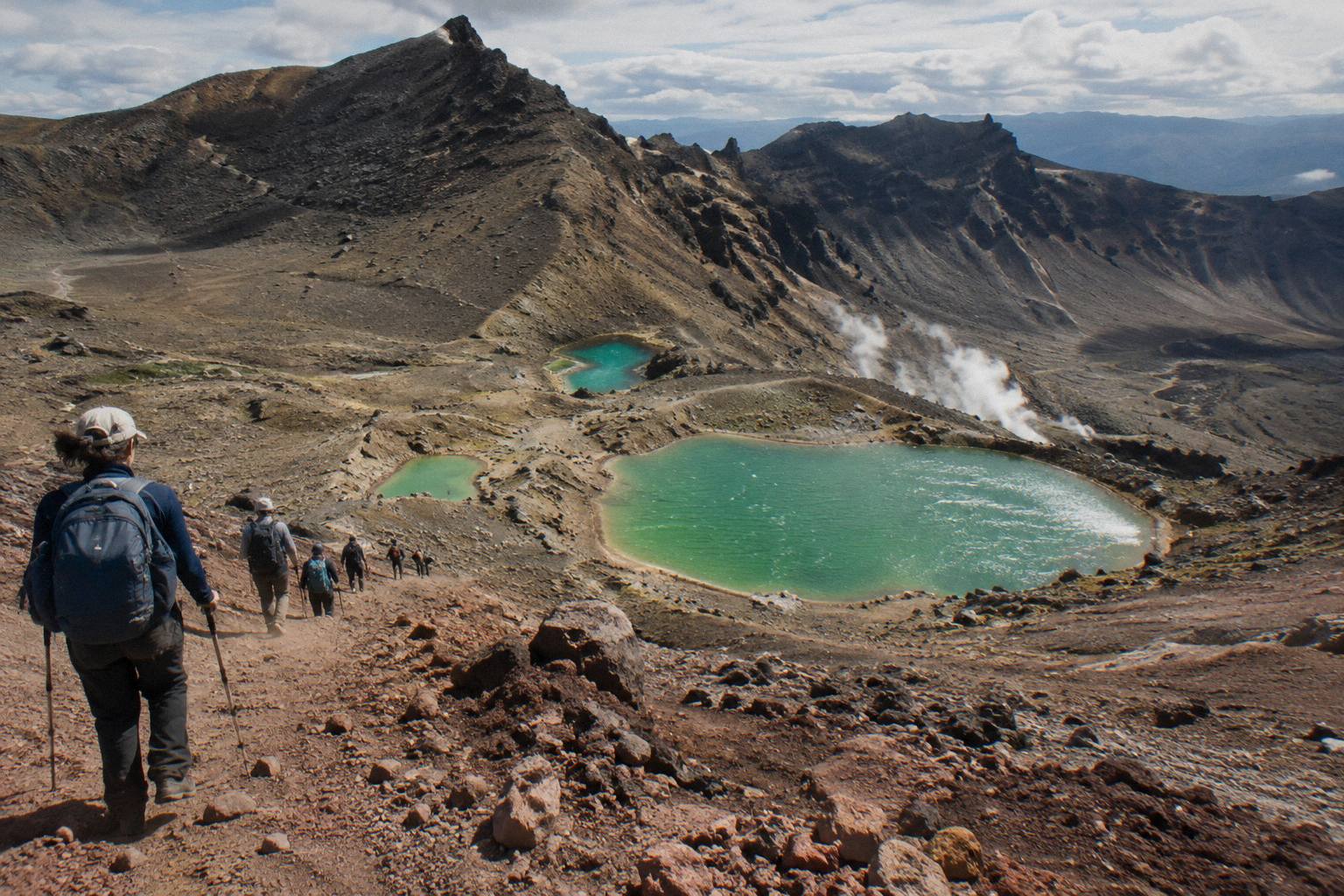
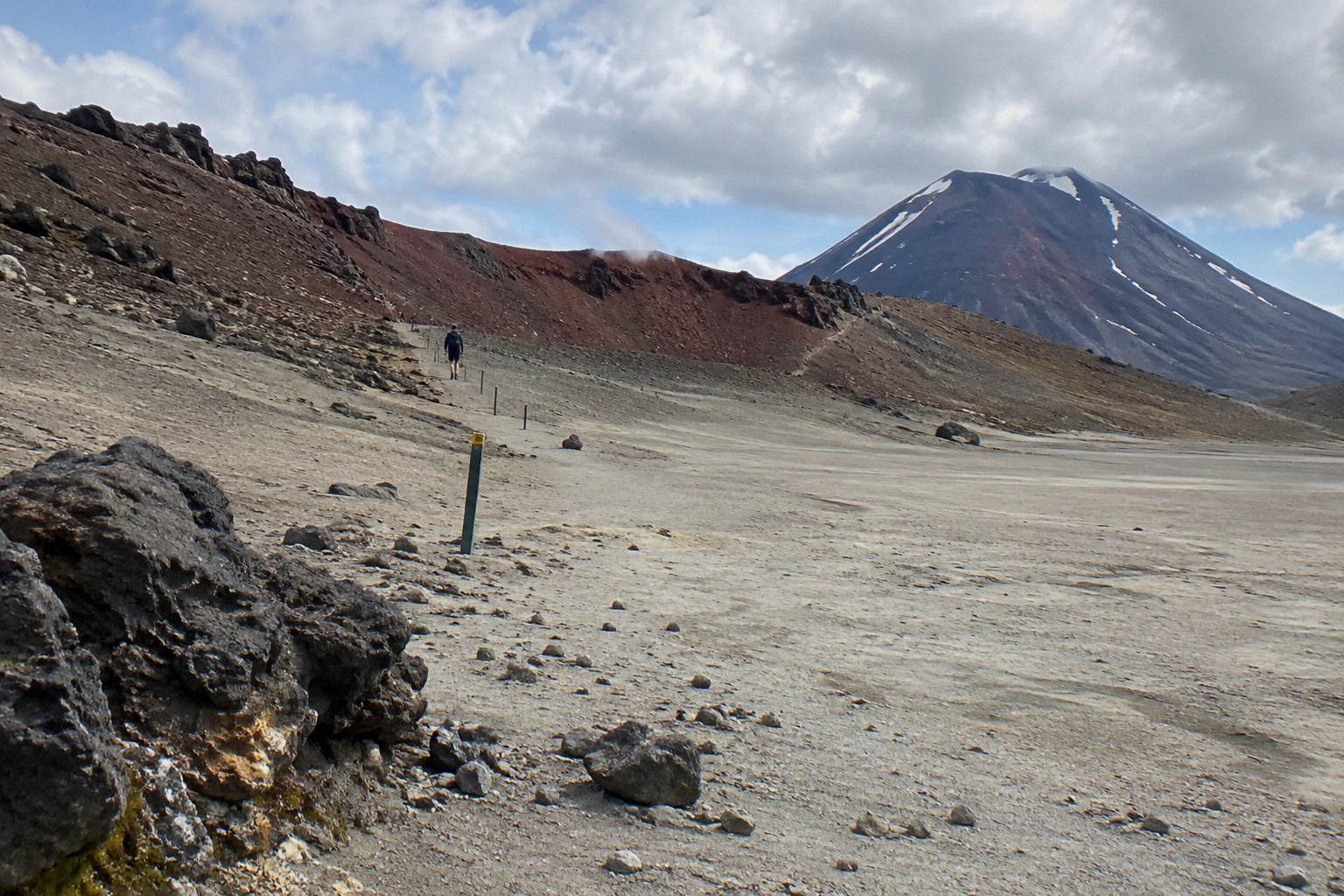
It helps to picture the sequence. The Devil's Staircase takes you from the Mangatepopo saddle up the steep steps carved into the ridge. South Crater opens out as a flat, moon-like basin that many walkers mistake for a crater in the volcanic sense; it is a glacially carved basin between cones. From its far side the track climbs again, a long sidle then a steeper push, to the rim of Red Crater. Only from that rim, looking down the coloured slope on the far side, do the Emerald Lakes suddenly appear, close enough to hear the steam vents hissing on the slopes beside them. The full route and where each landmark falls on it is mapped in a separate guide.
The three lakes are explosion craters, small hollows blasted out of the plateau by volcanic steam eruptions, and their green comes from dissolved minerals washed down from the thermal area above, particularly from Red Crater's fumaroles. Rainwater collects in the craters, reacts with the minerals, and the pools stay vividly coloured year round, though the exact shade shifts with the light and the mineral concentration. They sit just off the track's line, close enough to walk beside but, per the cultural request detailed below, not to enter.
One practical note about what "two thirds" means for your legs. By the time you stand above the Emerald Lakes you have completed the Devil's Staircase and both big climbs, and the remaining distance is mostly downhill to Ketetahi Road. That is why so many tired walkers describe the lakes as the emotional summit of the day even though Red Crater, a few minutes earlier, is the literal high point.
| Landmark | Order On The Track | What Happens There |
|---|---|---|
| Mangatepopo start | Beginning | Track begins at about 1120 m |
| Devil's Staircase | First quarter | Steep stepped climb up the ridge |
| South Crater | First to middle third | Flat basin traverse between cones |
| Red Crater rim | Two thirds | High point at 1886 m |
| Emerald Lakes | Two thirds, just past Red Crater | Steep scree descent to the three green lakes |
| Central Crater and Blue Lake | Final third | Gentle traverse then the long descent |
| Ketetahi Road finish | End | Track ends near 760 m |
DOC's own track page carries the authoritative distances and the seasonal grading, and it is the page to check before any Crossing day: the DOC Tongariro Alpine Crossing page.
How Hard Is The Walk To The Emerald Lakes?
The walk is genuinely hard: DOC grades the Crossing as high fitness, an intermediate tramping track from November to April and an expert route from May to October, and the lakes sit beyond the day's toughest climbing, the Devil's Staircase and the ridge to Red Crater at 1886 m, before a steep scree descent. Allow 7 to 8 hours of summer walking, not the 3 or 4 a map glance suggests.
The distance to the lakes is misleading because the track's character changes constantly. The first section from Mangatepopo is nearly flat, a gentle walk up the old volcanic surface. The Devil's Staircase then gains height fast on constructed steps, and it is where most people's breathing and thighs start negotiating. South Crater is a reprieve, flat and surreal. The climb to Red Crater follows, exposed to wind on the ridge, on loose ground in places.
The descent to the Emerald Lakes is its own skill. DOC's phrase for it, a steep scree descent, deserves respect: the surface is loose gravel and fine stone, your feet slide with each step, and tired legs late in the day make it the most common place for slips. Walking poles help more here than anywhere else on the track. Footwear with a stiff sole and real grip matters too, and the question of whether proper hiking boots are needed for the Crossing has its own detailed answer.
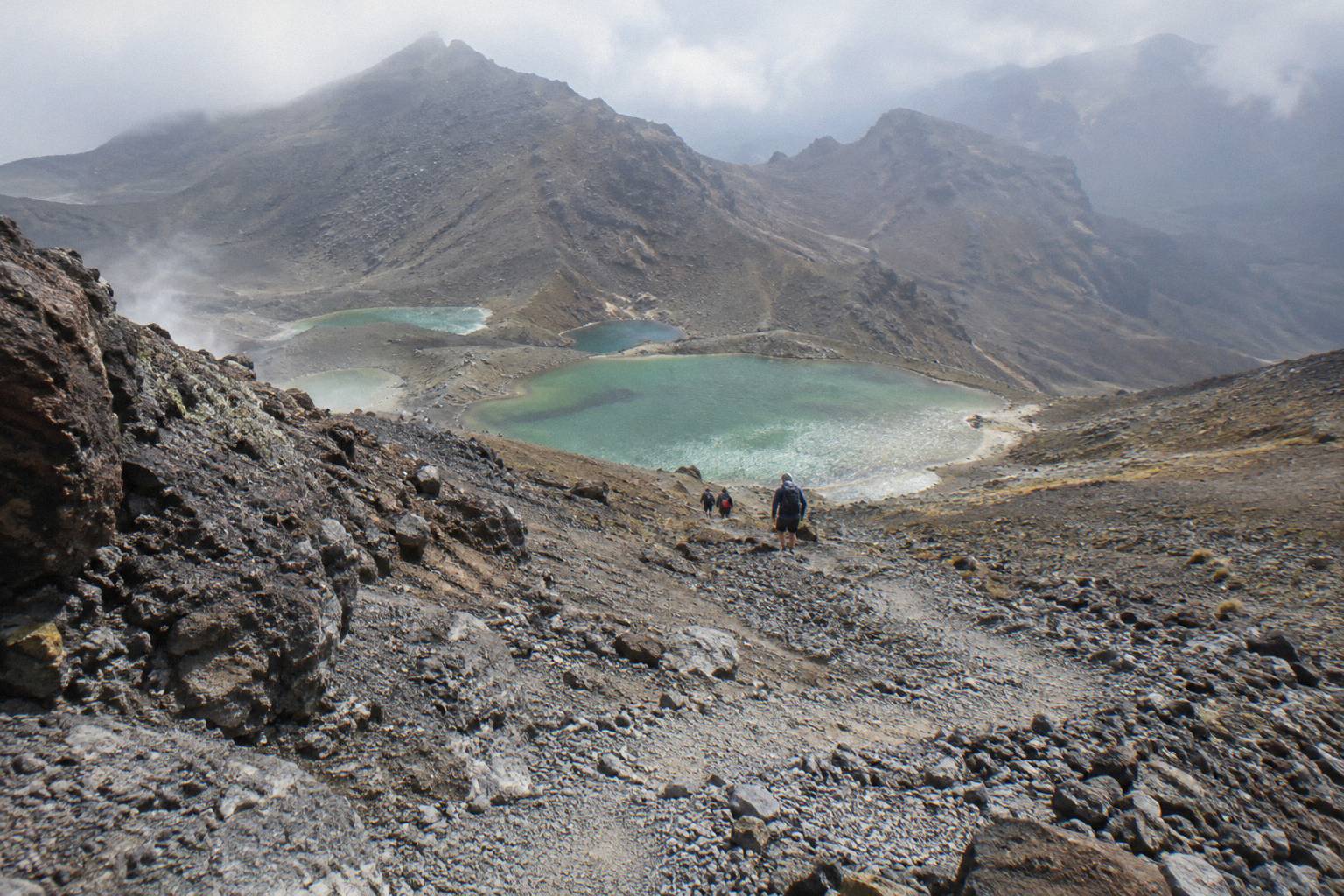
Fitness preparation is straightforward: the walk rewards sustained uphill walking over months rather than gym work over a week. Hills, stairs and long walks with a day pack cover most of it. The fitness profile for the climb to the lakes breaks the day into sections with what each demands. If the full 20.2 km sounds like too much, there is no short walk to the Emerald Lakes from either end; the lakes sit deep inside the track and every route to them crosses the high volcanic plateau.
Winter changes the calculation completely. From May to October DOC grades the route Expert: snow and ice cover the stairs and the scree, temperatures sit below zero, and avalanche risk applies. DOC's wording is that alpine skills are essential and it is best to go with a guide. The three Adrift Tongariro guided tours state that crampons and ice axes are supplied for winter conditions if required, plus a clothing and footwear allowance; the shuttles carry no gear at all, so winter walkers going independently need their own equipment and competence.
Between those two poles, guided and self-guided, sits a genuinely useful comparison. The Adrift Tongariro premium guided hike runs from NZ$450 per person, rated 4.6 across 242 reviews, with free cancellation up to 14 days before and a booked day of 8 to 9 hours including transport. The Tongariro Crossing Shuttles round-trip from National Park Village runs from NZ$75 per person, rated 4.7 across 890 reviews, free cancellation up to 24 hours before. The premium guided hike supplies a guide, gear for winter conditions and interpretation; the shuttle supplies transport and nothing else, which for a confident summer walker is exactly what is wanted.
Do You Need A Shuttle Or Can You Drive To The Start?
In the peak season, from Labour weekend in late October until 30 April, DOC restricts parking at both road ends to a 4 hour maximum, and the walk takes 7 to 8 hours, so driving yourself does not work. DOC's own advice is to book a shuttle. In the off-season the restriction lifts, but shuttles generally stop running from May to late October, while guided trips include transport.
The arithmetic is blunt. A 4 hour parking limit against a 7 to 8 hour one-way walk means the summer walker who drives will either rush the track or return to a problem at the far end. There is also a structural point DOC makes plainly: there is no parking for Crossing walkers at Mangatepopo car park in summer, and a private car park operates near Ketetahi. Several operators have built their whole product around this, offering secure parking at the Ketetahi end plus a one-way shuttle to Mangatepopo, so you walk the standard direction and finish at your own car.
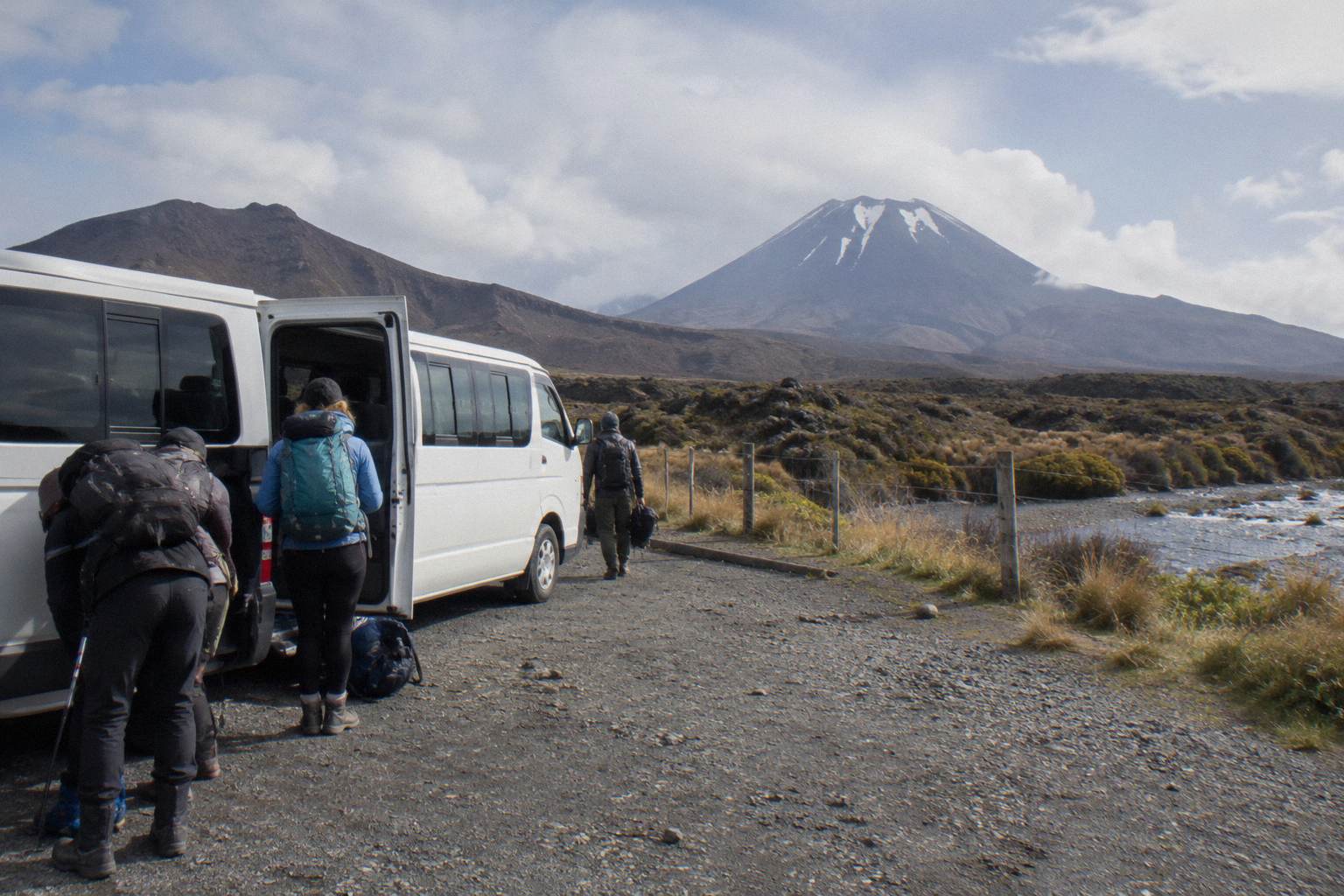
The options are wider than most first-time visitors expect, and the choice comes down to where you are sleeping the night before. From National Park Village, the Tongariro Crossing Shuttles round-trip runs from NZ$75 per person, rated 4.7 across 890 reviews, departing the Park n Ride at 59 Findlay Street, and the Dempsey Buses return bus from National Park Village runs from NZ$90 per person, rated 4.8 across 72 reviews. At the Ketetahi end, the Ruapehu Scenic Shuttles Ketetahi park-and-ride runs from NZ$68 per person, rated 4.8 across 670 reviews, with free cancellation up to 24 hours before, and the Owhango Adventures Ketetahi park-and-ride, rated 4.8 across 333 reviews, offers the same one-way structure. Further afield, the Tongariro Expeditions Crossing shuttle from Taupo or Turangi runs from NZ$75 per person, rated 4.7 across 431 reviews. Be clear on the mechanics: the Ketetahi products are one-way park-and-rides with no return transport, while the National Park Village, Taupo and Ohakune products are round trips. None of the shuttles is guided.
| Option | Operator | Type | From Price Per Person | Rating And Reviews | Cancellation |
|---|---|---|---|---|---|
| Round-trip, National Park Village | Tongariro Crossing Shuttles | Return shuttle | From NZ$75 | 4.7, 890 reviews | Free, 24 hours |
| Return bus, National Park Village | Dempsey Buses | Return shuttle | From NZ$90 | 4.8, 72 reviews | Free, 24 hours |
| Ketetahi park-and-ride | Ruapehu Scenic Shuttles | One-way shuttle | From NZ$68 | 4.8, 670 reviews | Free, 24 hours |
| Ketetahi park-and-ride | Owhango Adventures | One-way shuttle | Check the booking page | 4.8, 333 reviews | Free, 24 hours |
| From Taupo or Turangi | Tongariro Expeditions | Shuttle with transfer | From NZ$75 | 4.7, 431 reviews | Free, 24 hours |
| Premium guided hike | Adrift Tongariro | Guided group | From NZ$450 | 4.6, 242 reviews | Free, 14 days |
One detail worth knowing: DOC says part of a shuttle fee, about NZ$40, goes to conservation. The DOC booking system for the Crossing is free and recommended, and it is needed if you are booking a shuttle or guided trip; the booking system page explains how it works: DOC's Crossing booking system page.
If you are starting from Taupo, the Tongariro Expeditions shuttle from Taupo or Turangi removes the need to reposition to National Park Village the night before, at the cost of a longer transfer each way. Its booked day runs 8 to 10 hours door to door, and it is free to cancel up to 24 hours before. For walkers based in National Park Village itself, the Tongariro Crossing Shuttles round-trip covers the same logic with a shorter ride, and its 890-review track record at 4.7 makes it the most reviewed tour here.
What Is It Like Standing At The Emerald Lakes?
The arrival is sudden and sensory: one minute you are picking your way down loose red scree below Red Crater's rim, the next the three green pools are spread below the track, steaming vents on the slopes above them. The colour is genuinely mineral green, deeper than photos suggest in flat light and almost luminous when the sun is behind you. The stretch beside the lakes is the busiest rest spot on the track.
The naming matters to get right. Nga Rotopounamu is the DOC name, rotopounamu meaning greenstone waters, and there are three lakes, not one: a larger pair close together and a smaller one a little further along the track's line. Walkers often photograph only the first two and miss the third, which sits quietly a few minutes on with fewer people around it. The colour science behind the green and the question of how much time to allow at the lakes each have their own guides.
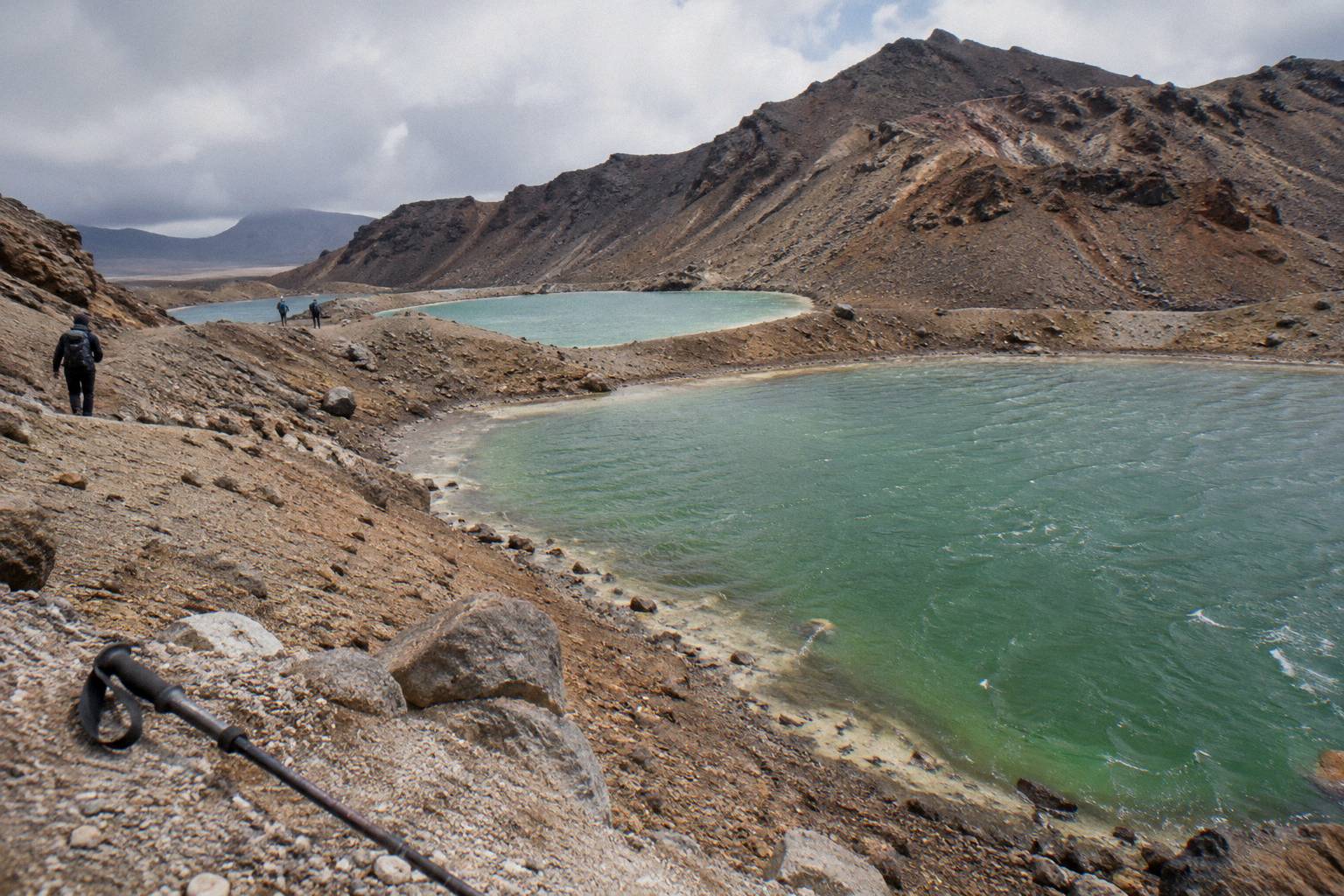
The cultural layer is the part many visitors arrive not knowing. The mountains of Tongariro are sacred to Ngati Hikairo ki Tongariro of Ngati Tuwharetoa, the park is a dual World Heritage area recognised for both nature and culture, and New Zealand's oldest national park dates to 1894. DOC passes on a request from kaumatua Te Ngaehe Wanikau: visitors are asked to respect the maunga tapu by not touching or entering any of the waterways, including the alpine lakes. So no swimming, no wading, no filling bottles. The request is printed as a request, and the overwhelming majority of walkers honour it simply by staying on the track and taking photographs.
Photography rewards planning. The lakes sit on the eastern side of the plateau, so mid-morning light arrives from behind you as you descend toward them, which is the combination that makes the green glow. Late afternoon walkers get the colours flatter and the scree hotter. The photographing the Emerald Lakes guide covers angles, timing and the third lake.
Should You Walk To The Lakes Guided Or On Your Own?
Adrift Tongariro runs the three guided tours, and in summer a fit, prepared walker does not need one; in winter DOC recommends a guide outright. The premium guided hike costs from NZ$450 per person against shuttle fares from NZ$68, so the decision comes down to season, confidence and how much interpretation you want. A guide adds safety judgement on the high plateau, gear in winter, and knowledge of the volcanoes.
The case for guided is strongest outside the November to April window. DOC's Expert grading from May to October is not advisory fluff: the stairs ice over, the scree descent to the lakes holds snow, and the guided tours are the products that state crampons and ice axes are supplied. The Adrift Tongariro premium guided hike, from NZ$450 per person, rated 4.6 across 242 reviews, departs National Park Village at 53 Carroll Street, with pickups from Taupo, Turangi and Whakapapa available at a surcharge on private trips. The Adrift Tongariro full-day guided Crossing, rated 4.7 across 278 reviews, covers the same track as a group day. Cancellation terms differ between them: the premium hike is free to cancel up to 14 days before, while the booking page shows the terms for the group day. Bring your own lunch on the Adrift days, as lunch is not included.
For a private party, the Adrift Tongariro private guided Crossing, rated 4.5 across 30 reviews, runs the walk for your group alone over a 7 to 9 hour booked day. The case for self-guided is equally simple in summer: the track is obvious, the season is staffed with other walkers, and the shuttles solve the only real logistical problem, the car. The guide worth-it question is examined in depth elsewhere on the site, including the winter argument.
| Factor | Self-Guided With Shuttle | Guided With Adrift Tongariro |
|---|---|---|
| Season fit | November to April | All year, recommended May to Oct |
| Cost | From NZ$68 shuttle fare | From NZ$450 premium guided |
| Gear | Bring your own | Crampons and ice axes supplied for winter |
| Interpretation | None | Guide throughout |
| Transport | Included in shuttle product | Included in the day |
| Cancellation | Free up to 24 hours on most | Premium free up to 14 days |
| Pace | Your own | Group pace |
For the National Park Village based walker who wants a return bus rather than a round-trip shuttle product, the Dempsey Buses return bus from National Park Village runs from NZ$90 per person, rated 4.8 across 72 reviews, with pickup points including the Park Hotel Ruapehu and the Tongariro Crossing Lodge. Children under 6 are excluded on the Dempsey services, and DOC separately advises the track is not recommended for children under 10.
What Trips People Up On Emerald Lakes Day?
The recurring mistakes are parking-related, timing-related and respect-related: driving to a road end with a 4 hour summer limit, underestimating the 7 to 8 hour walking time and starting too late, treating the scree descent to the lakes as a walk-down rather than the slipperiest section of the track, and touching or entering the lakes against the cultural request. None of these are exotic errors. All of them are made every busy summer week.
The parking trap catches visitors who have read older advice. DOC's restriction, a 4 hour maximum at the road ends from Labour weekend until 30 April, is recent enough that plenty of guidebooks predate it, and the enforcement reality is simply that the walk cannot be done inside the window. The fix is any shuttle product; the shuttle planning for the lakes day guide lays out the options by departure point.
Timing is the second. The walk is 7 to 8 hours in summer, the daylight is long, but the high plateau is exposed, and DOC assesses conditions each morning before operators run. Guided operators and shuttles run only when the DOC advisory and the forecast allow, so a booking is always conditions allowing, never a guarantee the day proceeds. Weather on the plateau is its own subject, covered in the Crossing weather above the lakes, and when the day is poor DOC names Taranaki Falls and Tama Lakes as the alternative walks.
The third is the descent itself. The scree below Red Crater moves underfoot, and the lakes draw the eye downward, which is exactly when feet slip. Slow down, shorten your steps and save the photographs for the flat stretch beside the pools. The descent from Red Crater to the lakes has a full technique section.
The fourth is the water. The request not to touch or enter the lakes, including the alpine lakes, comes from Ngati Hikairo ki Tongariro via DOC, and it applies to paddling and bottle-filling as much as swimming. It costs nothing to honour and it is the single behaviour the mana whenua have asked visitors for.
| Common Mistake | Why It Bites | The Fix |
|---|---|---|
| Driving to a road end in summer | 4 hour parking limit, 7 to 8 hour walk | Book any shuttle product |
| Starting late | Afternoon weather and exposure on the plateau | Take the early start shuttles offer |
| Rushing the scree to the lakes | Loose surface, tired legs, slips | Poles, short steps, slow down |
| Touching or entering the lakes | Against the cultural request | Stay on the track, photograph only |
| Assuming the day will run | Conditions are assessed each morning | Check DOC and the forecast, book refundable |
Which Tour Should You Actually Book For The Emerald Lakes?
For most readers the answer is the Tongariro Crossing Shuttles round-trip from National Park Village if you are staying near that village, from NZ$75 per person, 4.7 across 890 reviews, free cancellation up to 24 hours. Choose the Ruapehu Scenic Shuttles Ketetahi park-and-ride, from NZ$68, if you prefer to finish at your own car, and the Adrift Tongariro premium guided hike, from NZ$450, if you want a guide, winter capability or the interpretation.
The tie-breaker questions are quick to answer. Where do you sleep the night before? National Park Village points to the round-trip shuttles from the Park n Ride at 59 Findlay Street; Ketetahi-side accommodation points to the park-and-rides; Taupo and Turangi point to the Tongariro Expeditions transfers. What season is it? Summer makes the shuttle the efficient choice; winter makes the guided products the only sensible ones. What is your confidence on alpine terrain? The high plateau between South Crater and the lakes is exposed and serious in wind, and a guide removes the judgement calls.
The Tongariro Expeditions Ketetahi park-and-ride, rated 4.3 across 106 reviews with free cancellation up to 24 hours, is another one-way option at the same end of the track, running a self-guided hiking day. Whichever product you take, the day itself is the same one: an early start, the Devil's Staircase, South Crater, Red Crater at 1886 m, and then the three green pools waiting below the scree.
Common Questions About The Emerald Lakes
Where Exactly Are The Emerald Lakes On The Tongariro Crossing?
They sit on the volcanic plateau directly below Red Crater, at 1886 m the track's high point, roughly two thirds of the 20.2 km distance from the Mangatepopo start. The track descends steep scree from the Red Crater rim straight past them, so no side trip is needed.
Can You Swim In The Emerald Lakes?
No. DOC passes on a request from Ngati Hikairo ki Tongariro kaumatua Te Ngaehe Wanikau that visitors respect the sacred mountains by not touching or entering any of the waterways, including the alpine lakes. That covers swimming, wading and filling bottles.
How Long Does It Take To Walk To The Emerald Lakes?
DOC grades the full Crossing 7 to 8 hours of walking from November to April and 9 hours from May to October, and the lakes sit about two thirds of the way along. Most walkers reach them around the middle of their day, after the Devil's Staircase and the climb to Red Crater.
Is The Walk To The Emerald Lakes Hard?
DOC grades the track High fitness. The sections before the lakes include the steepest climbing of the day and a steep scree descent to reach them. In winter the route becomes an Expert track with snow and ice, and DOC recommends going with a guide.
Can You Drive To The Emerald Lakes?
No road reaches them; they sit deep inside the track. From Labour weekend in late October until 30 April, parking at both road ends is limited to 4 hours and DOC suggests booking a shuttle, which is why nearly everyone arrives by shuttle or guided tour in the peak season.
What Tours Go To The Emerald Lakes?
Every Crossing product reaches them. The Adrift Tongariro guided tours walk there with a guide, and the shuttle products from National Park Village, Ketetahi, Taupo, Turangi and Ohakune support a self-guided walk, with fares from NZ$68 per person and the premium guided hike from NZ$450.
Keep Reading
If this guide has settled the where and the how, the next pieces worth reading are the full Crossing map with the lakes marked, the descent from Red Crater to the lakes, the sunrise start guide for the lakes and the guide to Blue Lake, the next landmark on the track. Each one covers a single section of the walk in more depth than this overview can.